Bitcoin has been in the news for over a decade. Yet most people still can't explain exactly how it works. That's not a problem with Bitcoin. It's a problem with how Bitcoin gets explained. Too much jargon, too many technical tangents, not enough plain language. This guide is different. No assumed knowledge. No blockchain buzzwords for the sake of it. Just a clear explanation of what Bitcoin is and how it actually works.
What Is Bitcoin?
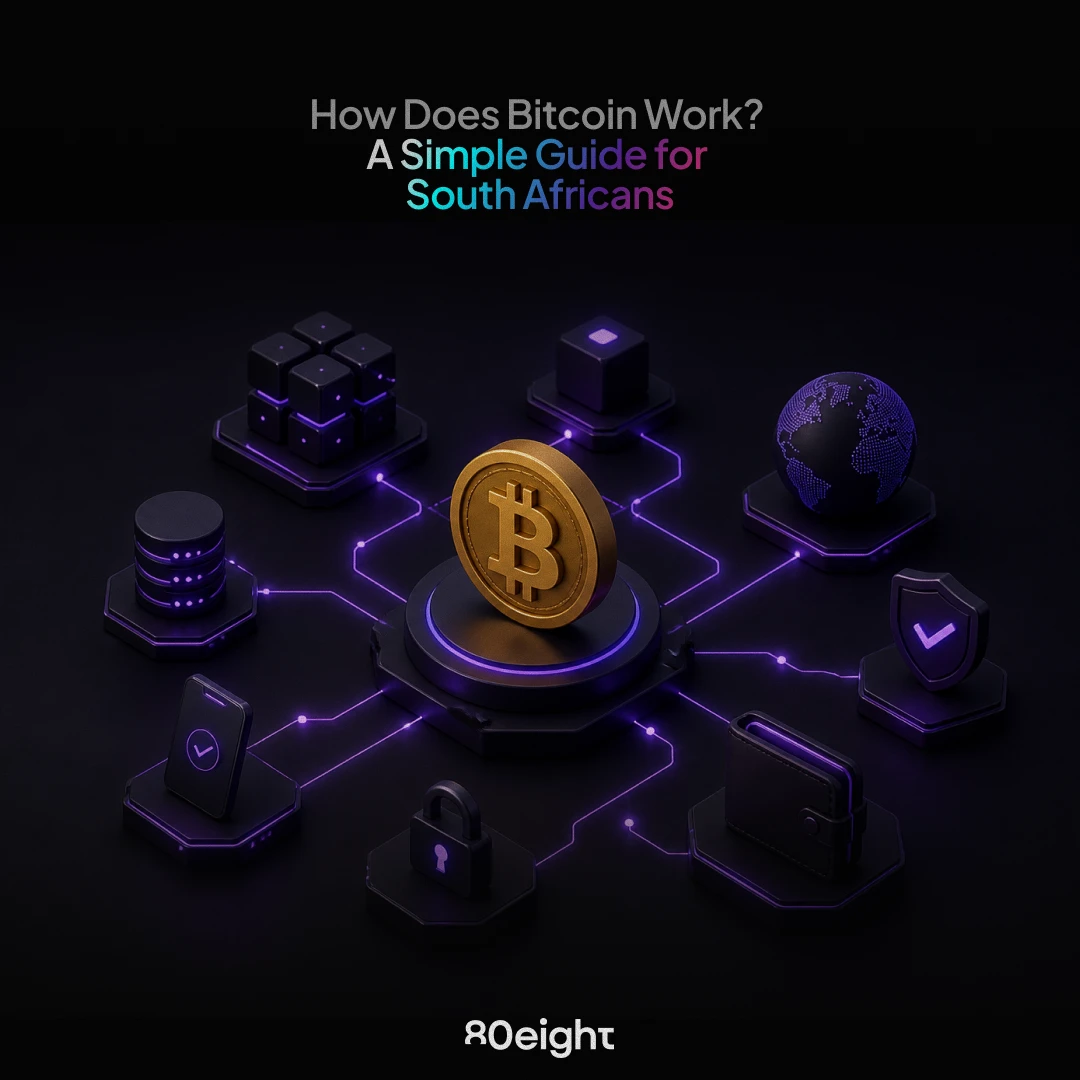
Bitcoin is digital money. It exists as code on a global network of computers. There's no central bank that controls it, no single company that runs it, and no physical coins. It was created in 2009 by someone using the name Satoshi Nakamoto. The goal was to create a form of money that could move between people anywhere in the world without needing a bank in the middle. Since then, it has grown into the largest digital asset in the world by market value, with millions of users across every continent.
What Is the Blockchain?
Every Bitcoin transaction ever made is recorded on something called the blockchain. Think of it as a public ledger, a giant record book that logs every transaction. What makes it special is that this ledger isn't stored in one place. It's copied across thousands of computers around the world. Every time a new transaction is added, every computer on the network updates their copy. This makes it extremely difficult to tamper with. To change a transaction, you'd need to change it on the majority of computers simultaneously. In practice, that's not feasible. That's the security behind Bitcoin.
How Are New Bitcoins Created?
New Bitcoins are created through a process called mining. Computers on the Bitcoin network compete to solve complex mathematical problems. The first computer to solve the problem adds a new 'block' of transactions to the blockchain and earns a reward in Bitcoin. This is energy-intensive by design. The difficulty of the problems keeps the creation of new Bitcoin predictable and controlled. There will only ever be 21 million Bitcoin in existence. This cap is built into the code. As of 2026, over 19.7 million Bitcoin have already been mined. Figures reflect data as at date of publication.
How Do You Send and Receive Bitcoin?
Every Bitcoin holder has a wallet. This wallet has two key components: a public address (like your account number, which you share to receive Bitcoin) and a private key (like your PIN, which you never share). When you send Bitcoin to someone, you're broadcasting a transaction to the network. The network verifies it using your private key signature and adds it to the blockchain. The recipient can then see the funds in their wallet. The transaction is usually confirmed within minutes. Once confirmed, it can't be reversed.
Why Do People Buy Bitcoin?
People buy Bitcoin for different reasons: Store of value: Some see Bitcoin as a way to preserve value over time, particularly in currencies that face inflation pressure. Speculation: Some buy with the expectation that the price will increase. Payments: Some use Bitcoin to send money quickly and cheaply. Diversification: Some hold Bitcoin as part of a broader investment portfolio. It's important to understand that Bitcoin's price is volatile. It has seen dramatic increases and significant drops. It's an asset with real risk attached.
The Bottom Line
Bitcoin is a digital asset that operates on a decentralised network, secured by cryptography, with a fixed supply and a transparent transaction record. You don't need to understand every technical detail to participate. What you need is a clear sense of what it is, how it works at a basic level, and what the risks are.
This content is educational and does not constitute financial or investment advice. Bitcoin and other crypto assets carry significant risk, including the potential loss of capital. Speak to a qualified financial adviser before making any investment decisions