Is South Africa uninvestable?
A commodity boom that did not lift the economy
You might have noticed the JSE hitting all time highs, powered by gold and platinum stocks. The irony is that SA has slipped from the world’s leading gold producer to around 10 th in the last 30 years.
Previous commodity booms have driven economic expansion, as Codera notes. This time it’s different.
South Africa’s mining volumes have declined for gold, diamonds and copper, and been fairly stagnant for other categories such as coal, iron ore and platinum group metals.
Investment at pre-democracy lows
SA’s investment rate has fallen to pre-democracy lows, as shown here:
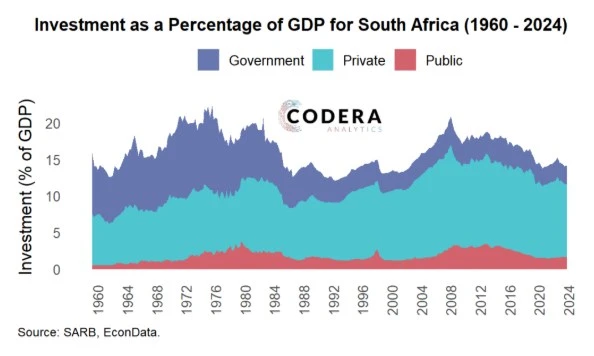
Private investment has been slowing for the last 15 years and even venture capital is at multi-decade lows.
Why capital goes elsewhere
The reason for this is the economic return on investment has been falling. Returns in Nigeria and Botswana are three times what they are inSA, says Codera, so foreign investors are avoiding SA.
Reserve Bank data shows that foreign investors have withdrawn from local equities and bonds over the last several years, although it is hard to quantify accurately since dual listed shares distorts this picture. However, South Africa’s share of global FDI is down by around 75%since 2010.
“Had the economy continued to grow at its’ pre-2010 trend growth rate, real GDP per capita would have been more than 30% higher in just15 years,” estimates Codera.
Nor is there much likelihood of breaking out of our sub-1%growth trap. The Reserve Bank expects 1.1% growth this year and 1.4% next year, while the Organisation for Economic Co-operation and Development (OECD) is more pessimistic, seeing little chance of annual growth above 0.1% between now and 2030.
Doubling down on what caused it
The government’s plan to arrest this decline involves doubling down on the policies that have been responsible for South Africa’s investment freeze and collapsing growth. The root cause of our economic stagnation is a philosophy of interventionism that assumes that economic growth requires redistribution, subsidies, and protection.
Meanwhile the size of the state continues to grow, with atax-to-GDP ratio of 27% (up from 21% in 1994), while subsidies and transfer payments now account for 12% of GDP (from 5% in 1994).
Ten percent of GDP on zombie SOEs
South Africa has spent the equivalent of 10% of a year’s GDP bailing out zombie state owned enterprises., as shown below:
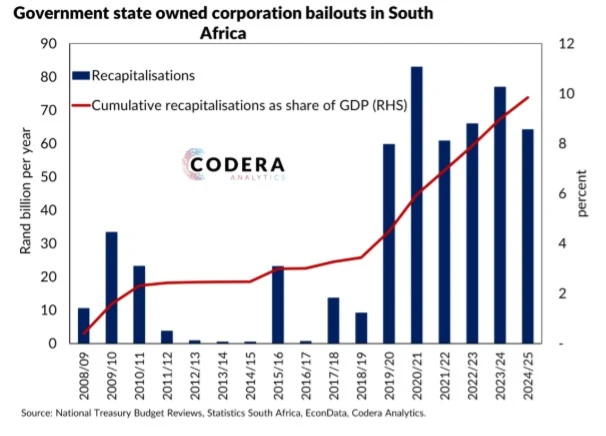
These subsidies protect capital intensive, oligopolistic industries that do not create many jobs.
“The underlying cause is increasing state interventionism, despite a collapse of state capacity. Reversing this requires a shift back to meritocratic appointments across all functions of government, privatisation of failing state owned corporations, prosecution of the corrupt, and structural reforms that align South Africa’s policy frameworks to global best practice,”says Daan Steenkamp, CEO of Codera Analytics.
It's a depressing prognosis, almost entirely man-made, that explains why SA is considered uninvestable.