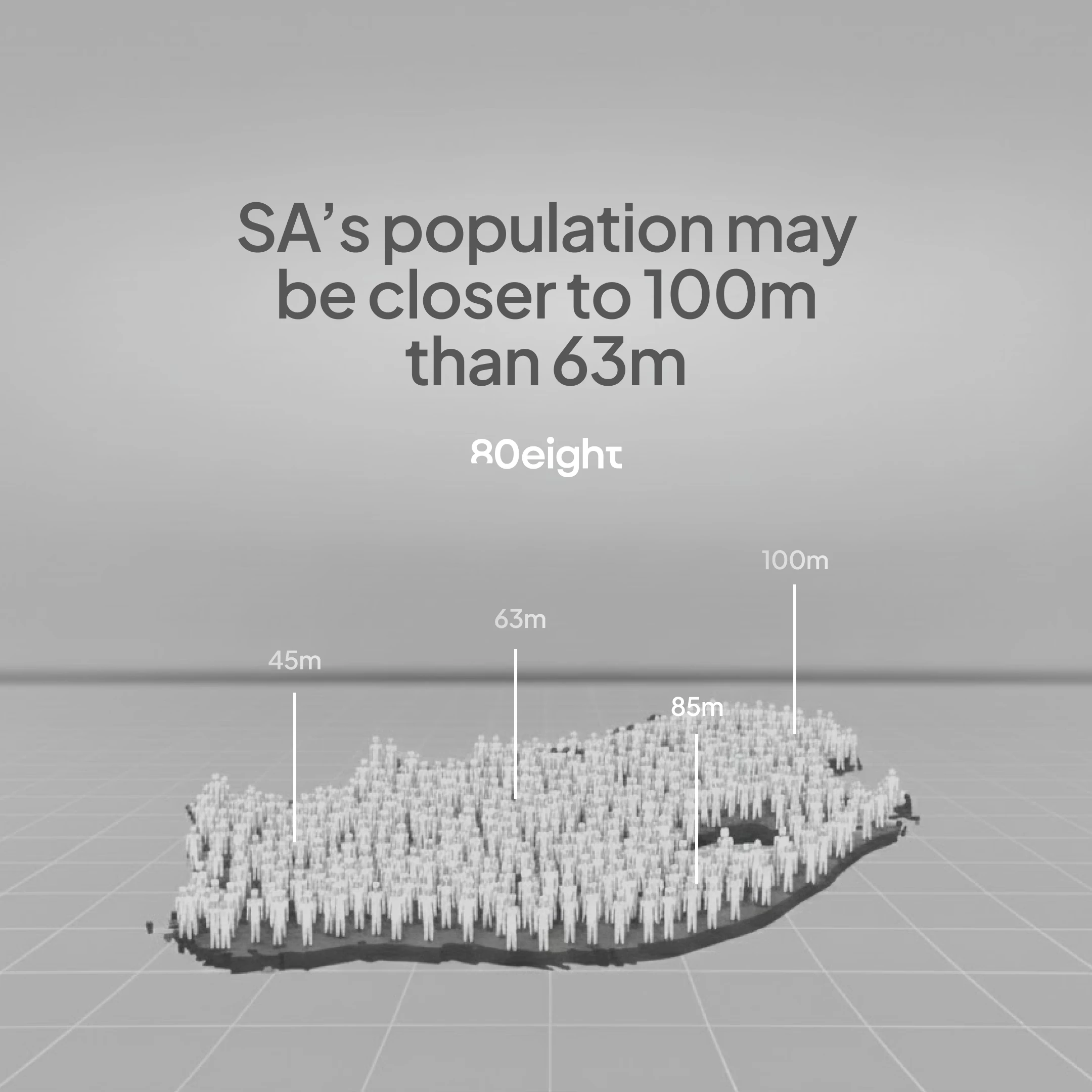
A fascinating story in Moneyweb suggests SA’s population could be 95 million, more than 50% more than the 63 million counted by Stats SA.
How Fibertime counts
This insight comes from township fibre operator Fibertime, which gathers granular, street-level data on the SA population. Fibertime connects informal households to uncapped fibre for just R5 a day.
Because the company owns its network infrastructure, it can detect how many devices connect to each router, how dense neighbourhoods are, and how residents use bandwidth. The company also uses drone photography of coverage areas, combined with AI and machine-learning tools, to extract additional demographic signals, such as car counts, roof counts and head counts.
It's these insights that led to the conclusion that Stats SA has the country’s population completely wrong. In fact, the upper end of the estimate puts the population at 123 million – double what the government uses for its planning purposes.
Why the Census undercounts
If that’s the case, we’re in trouble. The Census in 2022 is already acknowledged as a gros under-count, as many people simply don’t want anything to do with government head counters. Government uses these population counts to plan for water, electricity, housing, hospitals – just about everything.
If we have the population count so wrong, it’s no wonder that SA’s infrastructure is creaking. And as one commentator notes, why did do we have a bumper maize season, yet no experts – as was the case in previous years?
What it says about the borders
This also suggests the scale of illegal immigration is way beyond what was suspected, in which case our borders are virtually non-existent. Some have suggested these may be undocumented South Africans – but that can hardly account for the 50% under-count.
Magnus Rademeyer, former CEO and now head of insights at Fibertime, has vast experience in geographic information systems (GIS) and spatial modelling, having co-founded AfriGIS in 1997 – one of South Africa’s first mapping and location-intelligence firms where he was CEO and managing director for more than 20 years. He was also part of the Independent Electoral Commission’s national voting-district mapping project that created the electoral maps still in use today, says Moneyweb.