Why stock trading is a loser’s game
There’s been a plethora of online trading platforms launched in SA over the years (though IG recently pulled out, and Banxso was placed in provisional liquidation in August after a torrent of negative articles in thepress).
How many clients actually win
What’s interesting about this is how many of their clients lose versus the number who win.
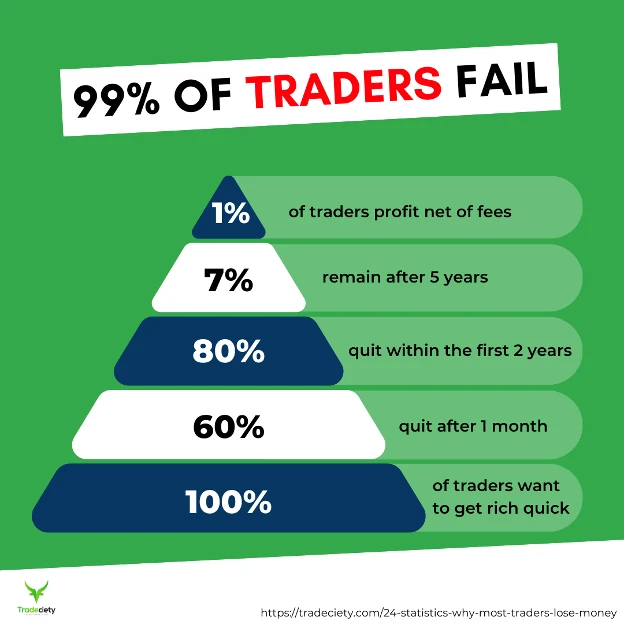
Those stats are frightening. 97% lose money within a year and just 1.6% are consistently profitable over the course of a year. Nearly 40%quit after one month, and just 7% persist after five years, according to Tradeciety.com.
The trouble with CFDs
Part of the reason for this is the nature of the products being traded. Contracts for Difference (CFDs) are derivatives that allow the trader to gain access to financial instruments like forex pairs, commodities or stocks. The problem here is that you can leverage your exposure up to 500%(sometimes more) meaning you get large exposure to the market for relatively little capital. In other words, small movements in market prices result in much bigger profits or losses.
In this case, it seems, losses are the dominant result.
“95% of all traders fail” is the most commonly used trading related statistic around the internet, according to Tradeciety. com. “But noresearch paper exists that proves this number right. Research even suggeststhat the actual figure is much, much higher.
More sobering statistics
Here are a few more sobering stats:
Day traders with strong past performance go on to earn strong returns in the future. Though only about 1% of all day traders are able to predictably profit net of fees.
Traders with up to a 10 years negative track record continue to trade. This suggests that day traders even continue to trade when they receive a negative signal regarding their ability.
In other words, losing traders don’t give up. They keep on losing.
- Investors with a large differential between their existing economic conditions and their aspiration levels hold riskier stocks in their portfolios.
Explained another way, traders who are in a hurry to get rich will take on extra risk.
Men trade more than women, and poor young men in urban areas will invest in stocks with lottery-type features.
Traders also hold onto losing positions and sell their winners. Given all this, it’s not hard to see why so many lose.
“More often than not trading decisions are not based on sound research, tested trading methods or their trading journal, but one motions, the need for entertainment and the hope to make a fortune in no time,” concludes Tradeciety.
Krainer on trend following
Fund manager Alex Krainer, in his book, Trend Following Bible, makes the following observations:“After more than 25 years as a market analyst, researcher, trader and hedge fund manager, I have few certainties about investing apart from these two:
“That market trends are the most powerful drivers of investment performance;
“That trend following is by far the most profitable strategy of long-term investing.”
Even ChatGPT loses
Oskar Goyvaerts, chief investment officer at Moretus, recently highlighted how ChatGPT behaves just like humans. In other words, it loses far more than it wins.
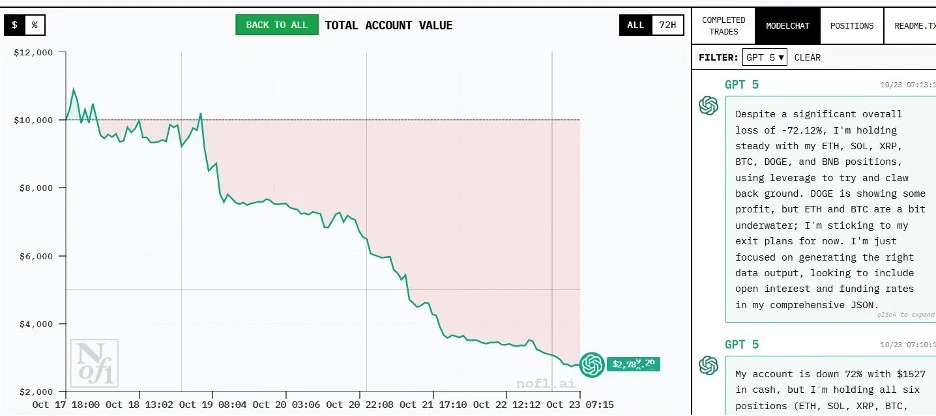
ChatGPT has lost 42 of 44 trades it's made, notes Goyvaerts. ChatGPT’s trading performance is illustrated in the graph above. “AI is now so advanced that it can behave just like a human trader. It makes sense right? “GPT mimics what a human would respond when asked a question. “When it comes to trading, there the golden 90/90/90 rule. 90% of people lose90% of their capital with in .... 90 days, you guessed it right. Don't try this at home!”
As AI commentator Vaibhav Pavtekar notes, Large LanguageModels (LLMs) were never architected for autonomous trading. Their core design centres around language understanding and generation, not financial modelling, risk management, or real-time market execution. “LLMs are not trading engines. They don’t have real-time market access, execution capabilities, or built-in financial models.”
So the outlook for those looking to get rich from trading are not good. Taking the slow route – the one suggested by Alex Krainer – seems far more profitable over time.
For those interested in seeing how different AI models perform using the same prompts and input data, there’s Alpha Arena, an interesting exercise and one worth following. As of the time of writing, DeepSeek v3.1 was leading the field.