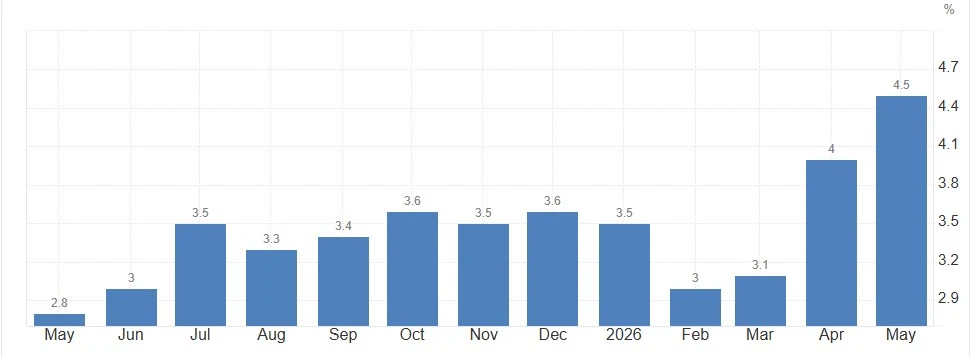
As expected, consumer price inflation jumped to 4.5% in May, but your lying eyes are telling you something else.
Inflation for most people is higher than this. Here’s why.
What has actually gone up
If you own a house, your mortgage rate is probably 9.5-10.5%. That’s gone up.
If you live in Joburg, your electricity tariffs have just gone up 12.4%.
Diesel prices have gone up nearly 50% in the last four months, and petrol 35-40%.
All of this is bleeding into other items, such as food – and there’s more to come.
How the CPI basket is built
The reason your eyes are telling you that CPI is more than 4.5% has to do with how they construct the CPI basket.
SA CPI inflation
Housing and utilities make up 25% of the CPI basket, food and non-alcoholic beverages 18% and transport 14%.
The basket does not match a poor household
The CPI food basket includes coffee and cream, when the average poor household is buying pap. Even data for many is a luxury.
Poor households do not own a house or a mortgage. Most of their money goes on rent, food and – increasingly – gambling. You know when gambling becomes a major household expense that you have a problem.
Nor do many of the people in these houses have a job. So ignore the claim that wages increased 5-6% over the last year, thereby keeping pace with inflation.
The poor do not keep pace with inflation. And in some rural areas, food prices are rising much faster than they are in the cities.
The official figures are not fabricated
Official inflation isn't fabricated. Stats SA's methods are internationally benchmarked and improved over time. Low single-digit inflation is better than the high rates of the past.
But for millions living close to the edge, inflation at 4–5% feels like a crisis when wages and jobs don't keep up.
Inflation is a quiet killer
People look at inflation as a static figure. Okay, so prices went up 4.5% over the last year. That’s not too bad. But it comes on top of CPI increases of 55% over the last 10 years. That also comes on top of electricity price increases of 900% over 10 years.
This is why inflation is a quiet killer. It is so incremental you don’t notice is as much as a short, sharp shock.
The basket is an average across urban households. It includes items like insurance, restaurants, communication, and durables that many people cut back on or don't buy frequently. For lower-income groups, food alone can be 30–40%+ of spending, and their specific basket experiences higher inflation.
The lesson to learn here is that inflation will not stop. It is an inevitable by-product of centralised government control and the massive bureaucracy that it spawned (1.5 million public sector workers).
Government is not coming to save you. It is coming for your savings through the slow boil of inflation. The only solution is to get going with another side hustle and build your business in such a way that your income can out-pace inflation.