Dollar Cost Averaging: your path to wealth building
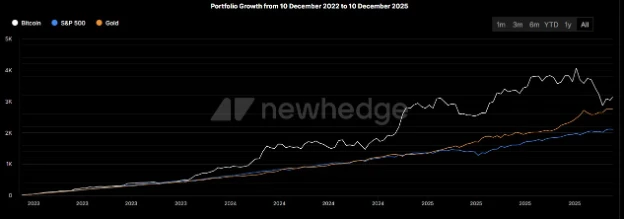
We wrote about dollar cost averaging here.It takes a little discipline but the rewards are there for the taking. The chart below shows what would have happened if we invested R1,000 a month beginning in January 2023 in bitcoin (white), gold (orange) and the S&P 500(blue).
Bitcoin is clearly more volatile than the rest, but it’s also the best overall performer.
What dollar cost averaging is
Dollar cost averaging (DCA) – or rand cost averaging – is where you invest the same amount every month (or week) without paying any attention to price. It’s a disciplined way of saving and building wealth.
Bitcoin since January 2023
Investing in bitcoin at regular intervals shows you would have invested R15,700 since January 2023 and turned that into aboutR31,200.
You doubled your money.
Gold wasn’t too shabby but has not quite matched bitcoin’s performance. Nor has the S&P 500.
Why it beats timing the market
Instead of trying to time the market by investing a lump sum at what you hope is the lowest price, DCA involves investing a fixed amount at regular intervals – say R1,000 monthly – regardless of the asset's price.
This approach buys more shares when prices are low and fewer when they're high, lowering your average cost per share overtime. It's ideal for volatile assets like stocks or cryptocurrencies, as it mitigates the emotional pitfalls of market swings and harnesses the power of compounding.
Over long periods, DCA has proven effective for building millionaire status, especially with high-growth assets.
Three years across four assets
Let's explore how it would have performed over the past three years (December 2022 to December 2025) with Bitcoin (BTC),Nvidia (NVDA), Amazon (AMZN), and Microsoft (MSFT), assuming $100 monthly investments.
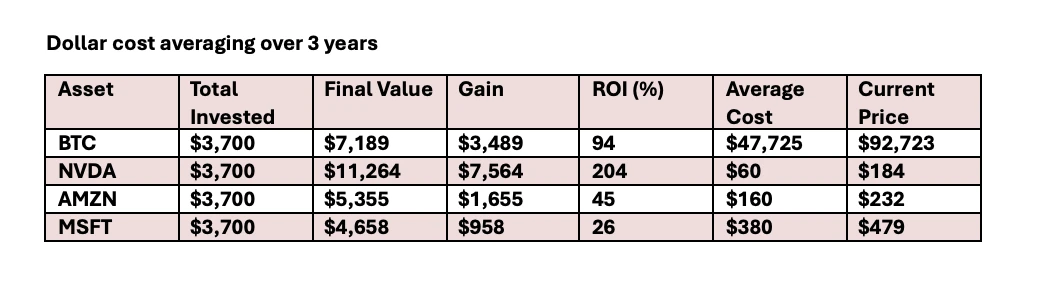
Nvidia outperformed BTC over three years, but the strategy worked no matter which asset you selected.
Through DCA, your average cost per BTC would be about $47,725, which is about half the current price of $92,000. This results in a portfolio value of roughly $7,189, yielding a gain of $3,489 and a94% return on investment (ROI). Without DCA, buying at a high point could have led to losses, but regular purchases smoothed the ride, capitalising on dips during bearish periods like early 2023.
‹Nvidia, the AI chip giant, offers a stellar example of growth stocks benefiting from DCA. With shares rising from about $14 (adjusted for splits) in late 2022 to $184 today, driven by tech booms, your $3,700 investment would grow to $11,264. The average cost per share was just $60.37. This translates to a whopping $7,564 gain and 204% ROI.
Amazon, the e-commerce behemoth, provides amore moderate case. Shares climbed from $85 in December 2022 to $232 now, fuelled by cloud computing and AI expansions. In this case, the return on investment (ROI) was 45%.
While not as dramatic as Nvidia, it demonstrates DCA's reliability in steady climbers, avoiding the regret of missing entry points during volatile earnings seasons.
Microsoft, a tech staple, rounds out the examples. From $240 in late 2022 to $479 today, bolstered by Azure and AI integrations, your investments would yield $4,658 in value. The ROI was 26%,the least attractive of the four assets selected above.
Consistency beats timing
DCA transforms market volatility into anally, proving that consistency trumps timing. Over three years, these examples show returns from 26% to 204%, far outpacing traditional savings. Start small, stay disciplined, and let time do the work—wealth awaits.
Sign up with 80eight. Get started here.