
One stablecoin to rule the world
Andreessen Horowitz’s State of Crypto report tells us much we already know, and much we don’t.
How many active crypto users are there
The report estimates that there are roughly 40-70 million active crypto users, an increase of about 10 million over the last year.
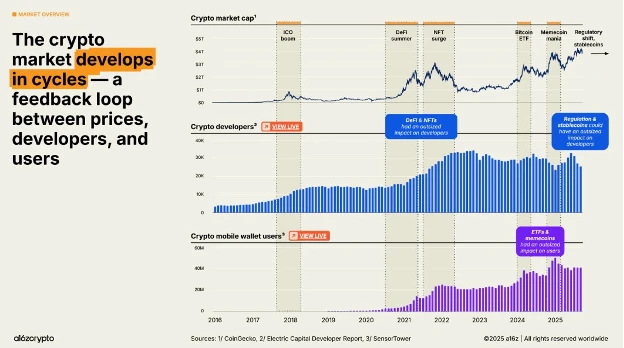
“The gap between passive crypto holders (people who own crypto but don’t transact on chain) and active users (people who transact on chain regularly) represents an opportunity for crypto builders to reach more potential users who already own crypto,” says the report.
Where they are, and what they do
So where are these crypto users, and what are they doing?
Crypto is global, but different parts of the world appear to use it in different ways. Mobile wallet usage, an indicator of on chain activity, is growing fastest in emerging markets like Argentina, Colombia,India, and Nigeria. (In particular, Argentina has seen a 16x increase in crypto mobile wallet usage over the last three years, amid an escalating currency crisis.)
Bitcoin, which still represents more than half of crypto’s total market cap, hit an all-time high above $126,000 as it gained traction among investors as a store of value. Meanwhile, Ethereum and Solana recovered much of their post-2022 drawdowns.
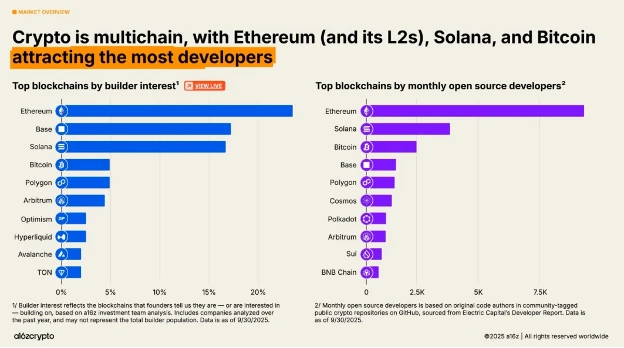
Most of the new development is happening on Bitcoin, Ethereum (on its Layer 2s) and Solana. This tells us something important – thefuture of crypto (apart from stable coins) is going to be a 3-5 horse race. To know where the winners will be, look at where the developers are focusing.Solana is one of the fastest-growing ecosystems, with builder interest increasing by 78% in the last two years.
Institutions have arrived
Institutional adoption has ramped up quickly. Traditional institutions — including Citigroup, Fidelity, JPMorgan, Mastercard, MorganStanley, and Visa — are now offering (or planning to offer) crypto products directly to consumers, allowing them to buy, sell, and hold digital assets, alongside equities, exchange-traded products, and other traditional instruments. Platforms like PayPal and Shopify, meanwhile, are doubling down on payments and building infrastructure for daily transactions between merchants and customers.
Stablecoins went mainstream
Stablecoins went mainstream
Nothing signals crypto’s maturity in 2025 more than the rise of stable coins which have done $46 trillion in transaction volumes in the last year. “In years past, stable coins were used mostly to settle speculative crypto trades; as of the last couple years, they have become the fastest, cheapest, and most global way to send a dollar — in less than one second for less than one cent, almost anywhere in the world.
“And this year, they became the backbone of the onchain economy,” says the report.
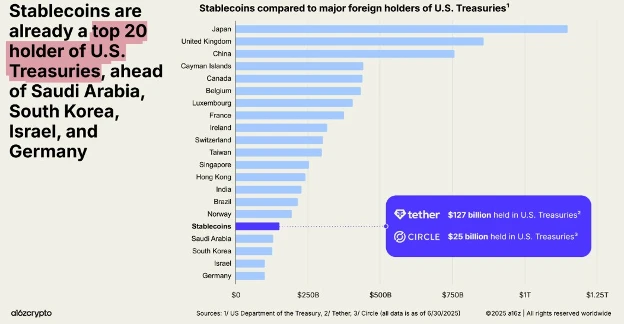
Stablecoins are already a top 20 holders of US Treasuries, just behind Norway and Brazil. Expect it to jump up to perhaps the largest holder in the next five years.
From centralised to decentralised
Another noteworthy trend: crypto trading is moving from centralised to decentralised exchanges. Also up are trade in tokenised real-world assets – now sitting at $30 billion, up nearly 4X in the last two years.
Prediction markets like Polymarket and Kalshi, built on the blockchain, have seen combined monthly trading volumes explode nearly 5X since the start of 2025.
All of this activity wouldn’t be possible without major advances in blockchain infrastructure. In just five years, aggregate transaction throughput across major blockchain networks has increased more than 100x. Then, blockchains processed fewer than 25 transactions per second.Now they process 3,400 transactions per second, on par with completed trades on the Nasdaq or Stripe’s global throughput on Black Friday — and at a fraction of the historical cost.