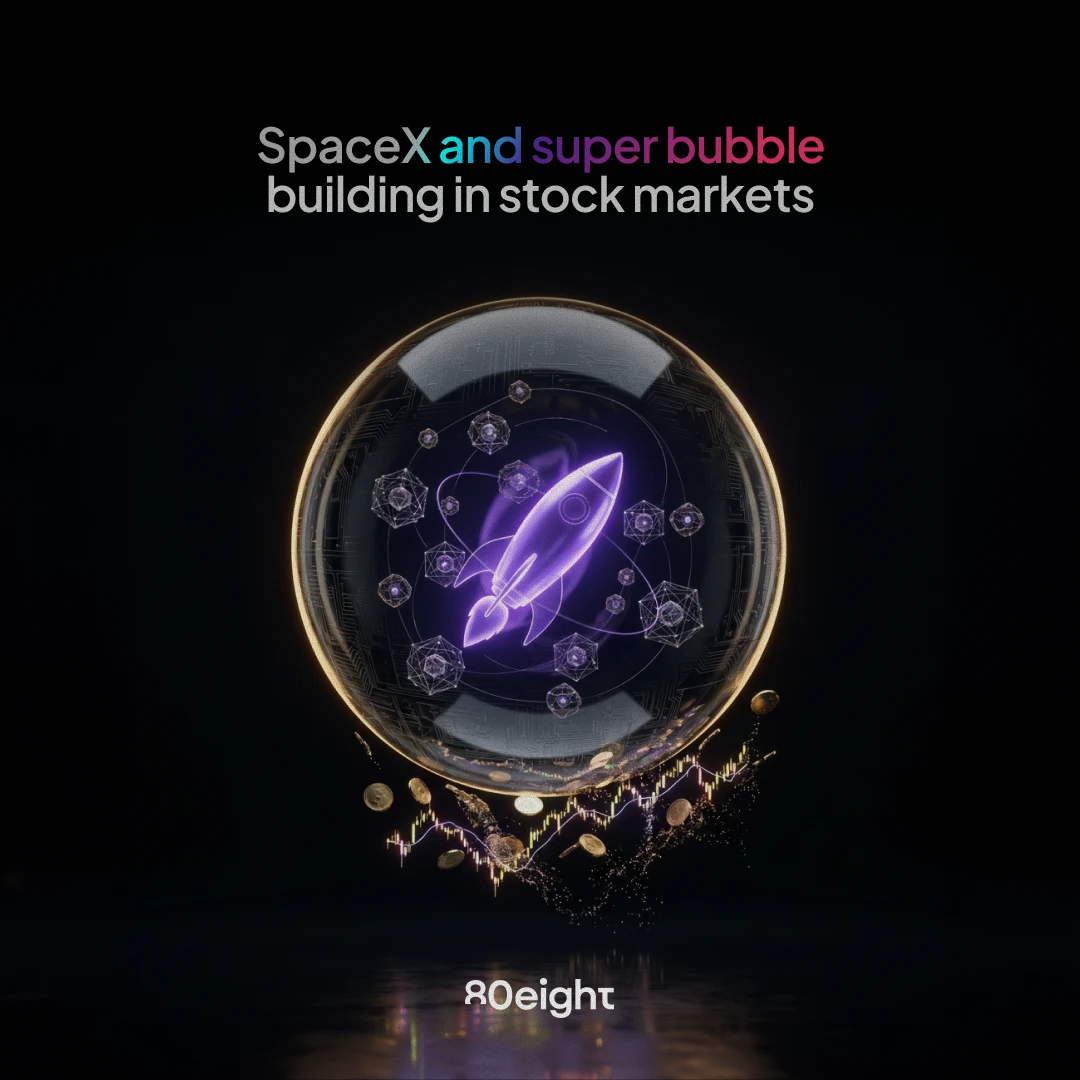
Legendary crisis investor Doug Casey believes the anticipated IPOs of SpaceX, OpenAI and Anthropic are all signs of a giant bubble about to wheeze out of control.
There are certainly signs of trouble ahead: the dotcom bust of the early 2000s, the 1929 market crash followed by the Great Depression (which would have corrected quickly had government stayed out of it) and even early calamities like the Tulip Mania of 1637, the Mississippi and South Seas Bubbles of 1720.
These events come around every century or so, which means we may be due for something sinister.
SpaceX, Starlink and the valuation
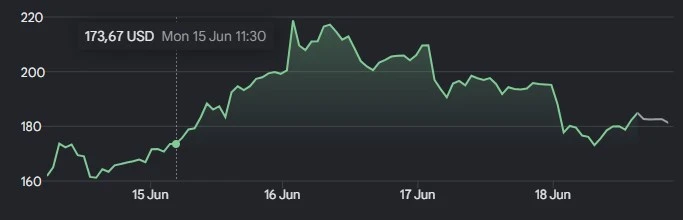
SpaceX is slightly profitable, but with a $1.8 billion valuation, it will have to deliver in buckets. Another part of the business is Starlink which is a big cash generator. What’s not so certain is the AI part of the business.
SpaceX share price
Three trillion-dollar IPOs
Casey points out that we are in for three trillion dollar IPOs in the coming months – the other two being Anthropic and OpenAI, both being pure bets on AI. “Include me out,” he says.
It’s worth remembering that the 1920s stock market boom (before the bust) was loaded with tech companies of the time – mainly car companies. They all went bust, leaving only GM, Ford, and Stellantis.
Today, the equivalent is the mass stampede into AI data centres. Hundreds of data centres are being built, full of servers, storage and cooling equipment. Hundreds of billions – even trillions – are being spent on these. These could end up being the biggest write-off in history.
Money supply and passive investing
A key driver of this speculative environment is the expansion of the US money supply. Massive government deficits and Federal Reserve monetary creation have injected trillions of dollars into the financial system, much of which has flowed into stocks and other assets. This has helped push valuations to historically insane levels, with the S&P 500 trading at a price-to-earnings ratio rarely seen in history.
What’s changed the nature of investing is the explosive growth of passive investing, exchange-traded funds (ETFs) and index funds. Rather than analysing individual companies, investors increasingly buy baskets of stocks through funds, often with little understanding of the underlying businesses. This has contributed to what Casey describes as an over-financialised market where speculation often dominates fundamental analysis.
He is particularly concerned about the possibility of large technology IPOs being included in major stock indices. If companies such as SpaceX are added to benchmark indices, index funds and retirement accounts would be forced to buy the shares regardless of valuation. This creates a self-reinforcing cycle in which demand from passive investors drives prices higher, encouraging even more buying and further inflating valuations.
Where value might be found
If the AI craze goes south – as Casey expects it will – where is value to be found?
Mining and energy stocks are relatively under-valued despite favourable long-term fundamentals. Gold, despite trading at record levels, has not attracted widespread public enthusiasm.
Investor enthusiasm for AI and mega-cap technology companies has reached extreme levels. The combination of easy money, speculative behaviour, passive investing and extraordinary valuations has created what may be the largest financial bubble in history, with potentially severe consequences when sentiment eventually reverses.