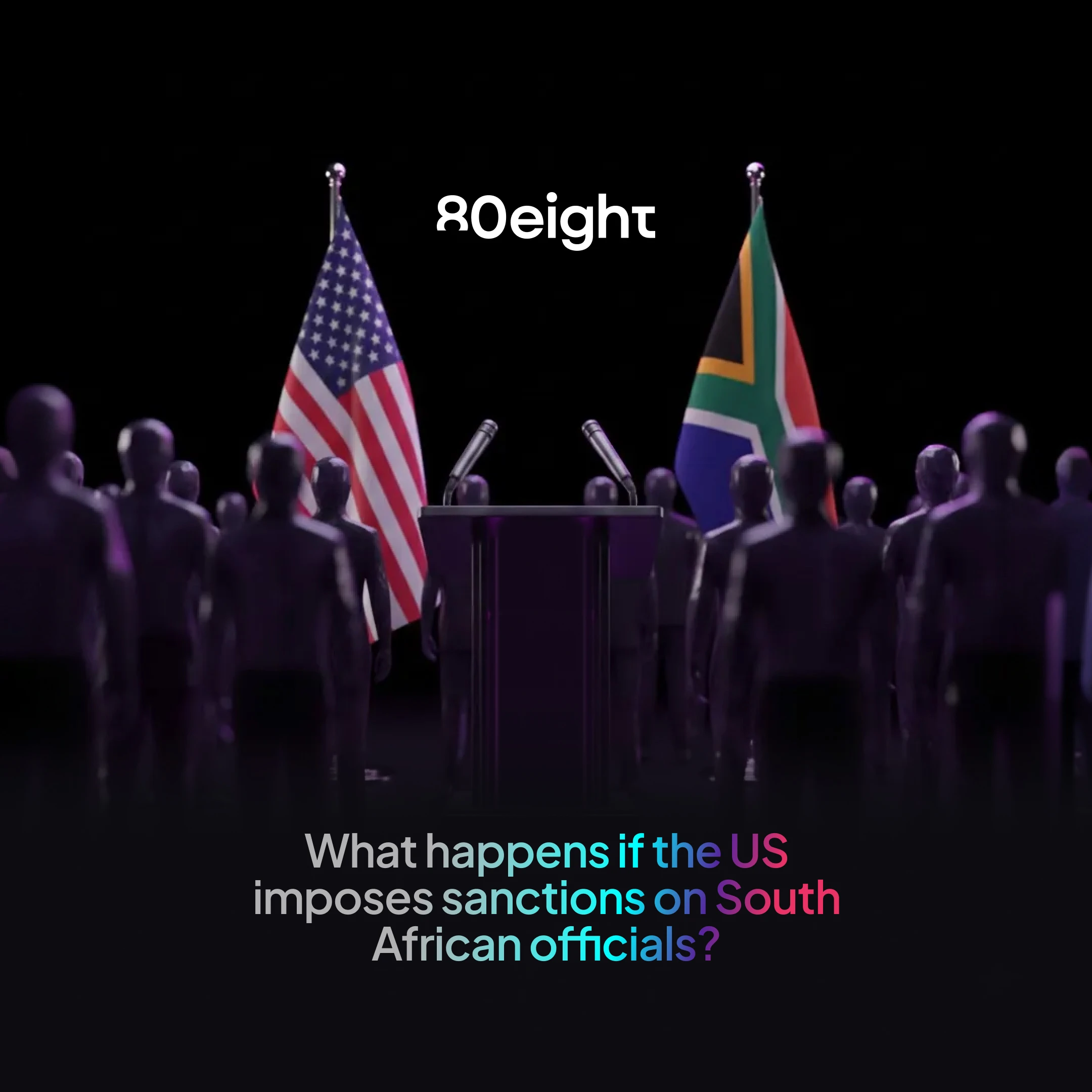
80eight CEO Faadil Moti joined Moneyweb’s Ciaran Ryan to discuss what would happen if the US started imposing sanctions on SA officials.
Here’s a brief summary of the interview (the full podcast is available here).
How sanctions usually start
Revoking former foreign affairs minister Naledi Pandor’s US visa suggests a shift towards personal, targeted pressure, and that’s usually how it starts – but the smart move is to prepare, not panic; SA could explore alternative payment networks to reduce dependence on US-dominated financial infrastructure, says Faadil Moti, CEO of 80eight.
The US is ramping up pressure on South Africa over its ties to Russia, China and Iran, as well as its accusations of genocide against Israel brought before the International Court of Justice in 2023.
Despite efforts to smooth out these wrinkles, the US continues to apply pressure on SA, leading to fears this could escalate into something more serious – such as sanctions against specific ANC officials and, what many consider the ‘nuclear option, placing restrictions on South Africa’s access to SWIFT, the international messaging system used by banks. “We are seeing increased pressure from the US. Revoking [former foreign affairs minister] Naledi Pandor’s US visa is a strong diplomatic signal. It suggests a shift towards personal, targeted pressure and that’s usually how it starts.
Political isolation before sanctions
“It’s not about sanctioning the country right away. It looks more like political isolation, weakening the international positioning of South Africa,” he says.
“The US is signalling its discomfort with South Africa’s global alignments, particularly with regards to Russia, China, and even [on] the Gaza issue. And the financial world watches these signs very closely.
“So a SWIFT ban or a visa ban today could lead to asset freezes or even blocked funds or blocked access tomorrow.
“Historically, this is how sanctions are sequenced. First, they are diplomatic, targeted at politicians, then financial. But what I can say is that South Africa is resilient. This is also a moment to build stronger bridges with our allies in the East and create redundancy in our financial infrastructure.
“In short, we do expect more noise, likely against individuals in certain sectors, but the smart move is to prepare, not panic.”
The alternatives to SWIFT
There are alternatives to SWIFT, such as China’s CIPS (Cross-Border Interbank Payment System), while Russia’s got its own SPFS system – both of them designed to circumvent the increasingly politicised SWIFT network.
However, can we rely on these alternatives to fill the gap if SWIFT is throttled? Steps are already underway to prepare for such an eventuality, adds Moti.
CIPS is gaining traction, and one of SA’s major banks has already integrated it for trade with China.
“These alternatives are real. They’re designed to bypass US-dominated rails. They may be a bit slower and more regional for now, but the adoption is growing, especially among the Brics nations. And South African banks are proactively exploring this, like we’ve recently seen.
Blockchain versus both
“So that tells you it’s not a theoretical exercise. It’s a defensive infrastructure play. Plus, big players like Mastercard are building stablecoin-compatible backend rails.
“And I think the next evolution may not just be CIPS versus SWIFT. It may be blockchain versus both,” says Moti.
“The smarter institutions aren’t waiting to be cut off. They’re obviously diversifying their flow paths today in order to remain consistent and to remain in business.”