The debate between crypto and stocks has been running for years. Both sides have strong arguments. Both sides have also been spectacularly wrong at various points.
Rather than tell you which is better, this guide gives you a clear-eyed comparison so you can make the decision that fits your situation.
There's no universal right answer here. There's only what's right for you.
How Stocks Work
When you buy a stock, you're buying a share in a company. You own a small piece of that business.
Your return comes from two sources: price appreciation (the stock becomes worth more) and dividends (the company shares profits with shareholders).
Stock markets are regulated and have been operating for over a century. Companies listed on exchanges are required to disclose financial information. The rules are established.
In South Africa, you can invest in local stocks via the JSE or in global stocks through funds or platforms that offer offshore exposure.
How Crypto Works (in Comparison)
Crypto assets are digital, decentralised, and not backed by a company's earnings or assets. Their value is driven by utility, adoption, supply dynamics, and market sentiment.
Returns are primarily from price appreciation. Some assets offer yield through staking (locking up your crypto to support a network and earn rewards) or lending, but the core return driver is price movement.
The market is newer, less regulated, and more volatile. It also operates 24 hours a day, 365 days a year. There's no closing bell.
Risk Profile: How They Compare
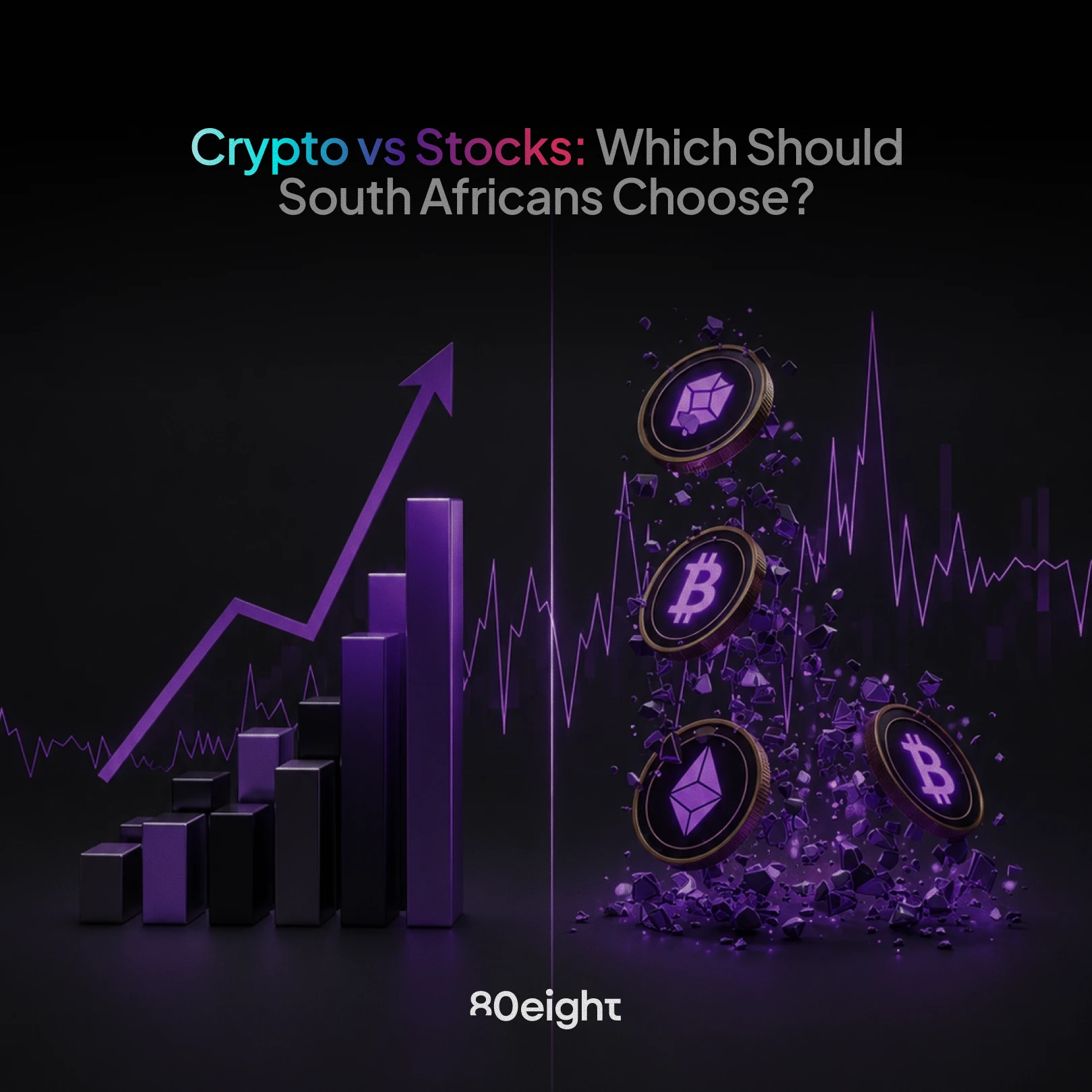
Volatility: Crypto is significantly more volatile than most stocks. A 30–50% drawdown in a year is not unusual for major crypto assets. The same move in a blue-chip stock would be extraordinary.
Liquidity: Both are highly liquid. You can sell shares on the JSE during trading hours and crypto any time.
Regulation: Stocks have decades of regulatory infrastructure. Crypto regulation is evolving. In South Africa, crypto is now subject to FSCA oversight.
Counterparty risk: For stocks, your investment is backed by a real business. For crypto, there's no issuer or collateral. The value is entirely market-derived.
Returns: What the History Shows
In certain multi-year periods, Bitcoin has produced returns that exceeded traditional equity indices — though it has also experienced severe drawdowns in those same timeframes.
The JSE has delivered inflation-beating returns over the long term. It's more predictable, though SA equities face their own risks around economic performance and currency.
Global equities (particularly US-listed ETFs) have delivered strong long-term returns. Offshore ETF exposure is accessible to South Africans through regulated platforms.
Past performance doesn't predict future results. In either case.
The Case for Both
Most financial advisors would tell you diversification across asset classes is the sensible approach. Stocks provide stability, income, and regulated exposure to the global economy. Crypto provides exposure to a new asset class with different return drivers.
Some investors choose to allocate a small portion of their overall portfolio to crypto, treating it as a higher-risk, higher-upside position alongside more stable assets. What's appropriate depends entirely on your personal circumstances, risk tolerance, and investment timeline.
What matters most is your ability to stay calm when things go down. Because they will go down.
The Bottom Line
Crypto and stocks serve different purposes and carry different risks. Neither is inherently better. The right answer depends on you.
For those new to investing, understanding the difference in risk profiles between stocks and crypto is a useful starting point before deciding how to allocate. A qualified financial adviser can help you work out what makes sense for your specific situation.
This article is for general information purposes only and does not constitute financial advice. Speak to a qualified financial adviser before making any investment decisions.