If you believed every headline predicting Bitcoin's demise, you would have sold it hundreds of times over.
Since Bitcoin was launched in 2009, journalists, economists, central bankers and high-profile investors have repeatedly declared that it was finished, worthless or destined to fall to zero.
Yet 16 years later it remains one of the world's largest financial assets by market capitalisation.
The websites that count the obituaries
In fact, there are now entire websites dedicated to cataloguing Bitcoin's "deaths".
One of the best-known is Bitcoin Is Dead (bitcoindeaths.com), which has documented 475 published "obituaries" since 2010. You can see from the chart below that the number of obituaries is once again on the rise.
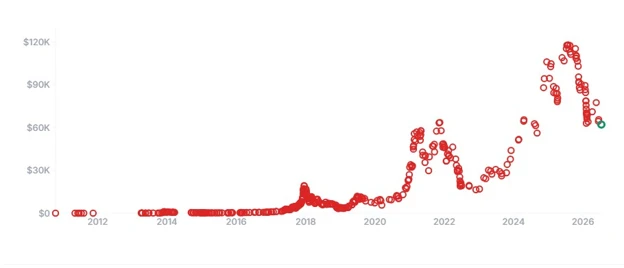
The number of times bitcoin has been declared dead , Source: Bitcoindeaths.com
What buying every obituary would have returned
Each entry records the original source, the author, the date and Bitcoin's price at the time the prediction was made. According to the site, if an investor had simply bought $100 worth of bitcoin every time it was pronounced dead, those purchases would today be worth tens of millions of dollars.
That’s an interesting takeaway.
Another long-running tracker, 99Bitcoins, maintains its own Bitcoin Obituaries database. It currently records more than 470 declarations that Bitcoin was dead or heading to zero, ranging from newspaper editorials and television interviews to comments by prominent economists and business leaders.
When the predictions cluster
Many of the predictions came during periods of extreme market stress, including the 2011 exchange hacks, the 2014 Mt. Gox collapse, the 2018 crypto bear market, the 2022 failures of Terra and FTX, and more recent price corrections. Each downturn sparked fresh claims that Bitcoin had finally met its end.
What this does and does not prove
None of this guarantees Bitcoin's future. It remains a volatile asset and there is no certainty that its long-term success will continue. But its history does offer one important lesson: markets often swing between excessive optimism and excessive pessimism.
The next time someone confidently predicts that Bitcoin is going to zero, it may be worth asking whether we've heard that story before. History suggests that we have – hundreds of times.